
Parsons vs. FIT: How to Prepare the Same Fashion Project for Two Portfolios
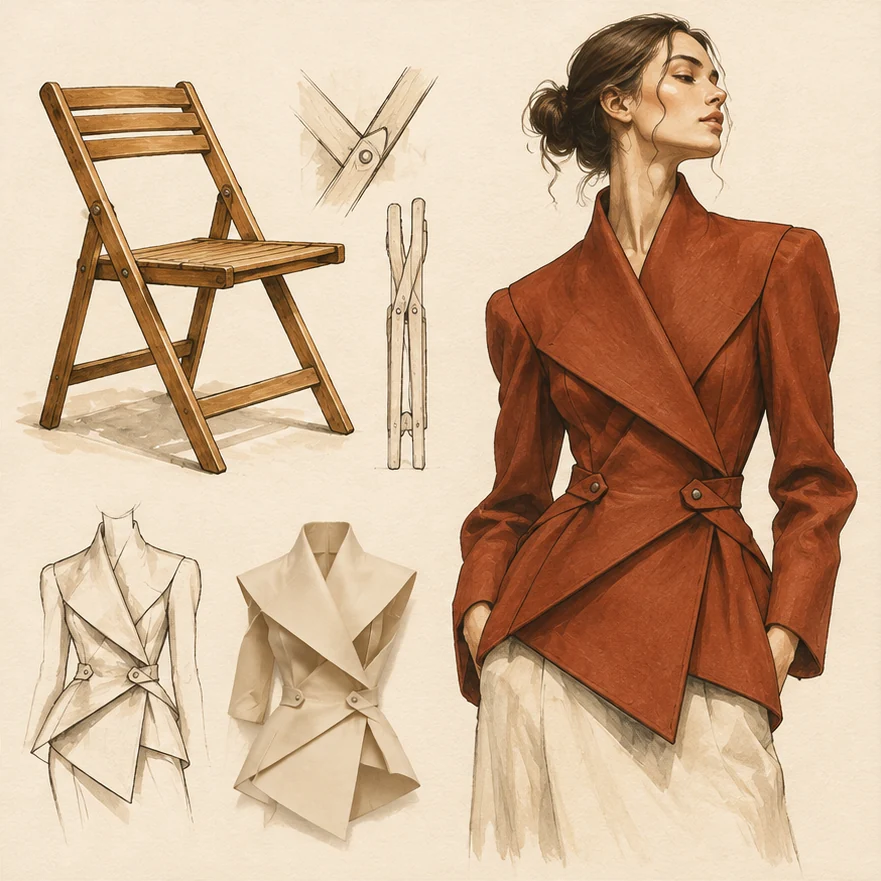
One jacket can start two very different applications. Imagine opening a folder that contains an observation drawing of a folding chair, a jacket inspired by its hinges, several fabric trials and photographs of the jacket you made. For a first-year Parsons BFA portfolio, the question might be which part of that investigation belongs beside your other creative work. For FIT’s Fashion Design AAS, the first question is which part of the current assignment each file could satisfy. The same folder gives you a starting point for both edits. It leaves you with different work to do.
This comparison covers first-year applicants to Parsons School of Design in New York and the FIT Fashion Design AAS in New York. The FIT examples use the Fall 2027 brief. Instructions checked November 22, 2026. The jacket and chair are illustrated editorial examples of how to read a brief. Develop your own concepts and application materials independently. FIT’s Fall 2027 rules prohibit generative AI in the development of submitted portfolio content. FIT’s entry-term portfolio directory · Parsons undergraduate portfolio guidance
Read the name of the degree before comparing the work
A high school applicant interested in fashion at Parsons is reading first-year BFA instructions. An applicant to the Fashion Design AAS at FIT is reading a different set of instructions from someone seeking advanced entry into FIT’s BFA. A search for “fashion BFA portfolio” can quietly point a student to the wrong program. Write the full degree name, campus and entry term across the top of your worksheet. Use that line again before you start any upload. Parsons undergraduate applications · FIT’s major-specific instructions
Think about the difference in terms of the reader’s first question. In an open portfolio, you choose which pieces speak for you and what they collectively reveal. In an assigned project, you need to make your choices visible within a set problem. There is room for invention in both. They place responsibility in different places. You can have an excellent drawing that answers a question you were never asked. You can also meet every technical instruction on an assigned board and still need to consider whether the designs work together.
Make two working folders now. Give each one its own checklist and leave the original artwork in a third, shared source folder. A front photograph, a reverse view, a fabric scan and a pencil drawing should survive both edits at their original resolutions. A Photoshop file designed around one portal’s page shape may be inconvenient for the other. Separating the source material from each export keeps a late change to one application from undoing an afternoon’s work on the other.
The comparison in one minute
| Decision | Parsons first-year BFA | FIT Fashion Design AAS, Fall 2027 |
|---|---|---|
| Starting structure | The main portfolio has 8–12 slides or images. Several media can appear, including fashion, drawing and sculpture. | Follow the sections for sportswear coordinates, creative artwork and sewing, plus a separate short essay. |
| What the jacket might contribute | A personal investigation, a resolved design or one part of a broader body of creative work. | An eligible design or sewing item when it meets the detailed instructions for that section. |
| Planning the views | Select views that explain the work, using the school’s guidance on legibility and supporting information. | Check each section for its specified figures, flat drawings, swatches and garment views. |
| Where to finish | Use the university’s application system and the directions provided after the Common Application. | Use FIT’s applicant portal to reach the appropriate SlideRoom submission for your major and term. |
Use this table to choose your next task. Keep the official instructions open for the actual submission. In particular, FIT’s directory lists Spring 2027 and Fall 2027 separately. A saved screenshot with the term cropped off can lead you to prepare the wrong photographs. At Parsons, first-year and transfer guidance also diverges. Official Parsons application page · Official FIT Fall 2027 brief
The project on the table
Start with a physical object you have observed closely enough to draw from more than one direction. In this demonstration, a folding chair interests the designer because a broad surface changes angle around a relatively small joint. A jacket shoulder can also project, collapse or pivot when the wearer moves. That relationship gives the designer something to investigate. Matching the color of a chair to a jacket would tell a different, much thinner story if no other decision connected the objects.
Imagine a folder containing a drawing of the chair standing open, a drawing of it halfway closed, four folded-paper trials, a sleeve pinned in plain cloth, a resolved illustration and views of a sewn sample. Two of the paper trials do almost the same thing. The plain-cloth sleeve looks awkward in profile, but you can see where the first fold catches the elbow. The finished illustration is stronger from the front. A photograph from behind shows a seam the drawing leaves ambiguous. These materials have different values depending on the question.
Now cover the finished jacket and read the working pieces. Can you identify which hinge interested the designer? Which experiment affected the jacket? What happened when paper gave way to cloth? If you cannot answer from what is on the table, the next task might be another observation drawing or a photograph taken halfway through the movement. Fresh evidence has more value here than a new title page. The missing picture would give you a meaningful choice in either edit.
Make the Parsons edit around a question
For a proposed Parsons sequence, try introducing the jacket with the view that makes its idea easiest to perceive. That could be the worn jacket with the arm reaching forward. Put the chair observation and one material trial beside it on the table. Temporarily remove every other image and see what a reader can infer. If the translation from hinge to sleeve is visible, two economical views might carry the project. If the relationship is still mysterious, the strongest third view is the one that supplies the missing step.
Look beyond fashion when you choose what comes next. A drawing of an ordinary room, a small sculpture or a sustained photography project may reveal how you observe space or tell a story. Ask what that work contributes to the whole submission. A school self-portrait assignment could earn its place because the treatment of reflected light is distinctly yours. Its subject alone provides little reason to keep or discard it. Parsons invites a range of media and encourages experimentation and personal perspective. Parsons Portfolio Help
Give the project an honest share of the available space. With a limited set of main slides, putting six views of one jacket into the sequence has a real cost. Lay out a version with one jacket slide and another with two. On the second, use the space for a decision that changed what someone can understand. Then place both versions among the other work. An extra jacket view that seems indispensable in isolation may crowd out the only piece that reveals your sense of humor or color.
Write the description while looking at the work. Determine what a person can already see, what you tried and what surprised you. Mention the specific change created by the test. At Parsons the description field is a useful place for context, and the school asks for process descriptions for at least two favorite works. Identify your own role when a piece involved collaboration. A short, accurate explanation keeps the eye on the work instead of making the reader decipher blocks of type inside an image. Parsons instructions on process and descriptions
Build the FIT edit one assignment at a time
Open the Fall 2027 instructions and start with the sportswear coordinates section. The assignment asks for a wardrobe that works in combinations. The concept jacket, if it is an original idea you developed independently, might account for one piece. It does not establish that the rest of the wardrobe coordinates. Before spending another hour rendering the fabric, draw the other pieces small on paper and test the combinations. A shoulder that looks beautiful over one neckline might hide the main feature of another top. Find that out in a thumbnail.
Build a private check sheet that corresponds to the current instructions. Give the mood board, the specified figure pages, the required back flats and the real fabric swatches their own places. Note where FIT asks for a repeated top and where accessories belong. Use a different mark for “made” and “visible in the exported file.” A swatch taped to a board can technically exist and still disappear into a shadow when you photograph it. Following directions includes making the requested information legible. FIT Fall 2027 sportswear instructions
Next, read the creative artwork section separately. Follow the detailed directions for fashion sketches, early pencil thinking and the other creative pieces. The updated brief makes room for creative work outside fashion in this section. A well-observed chair drawing may have a place there if it is your own and genuinely demonstrates a skill. Do not assume every promising item from a Parsons edit belongs in a FIT fashion-design slot. A piece can be strong and still belong in a different part of the application.
Clear the figures from the table when you plan the sewing section. Work out which two machine-sewn garments you will present and how you will document the requested front, back and inside views. FIT specifies a person or dress form for photographing garments and allows up to eight photographs for this section. A paper mock-up that informed a jacket can be valuable studio evidence while leaving the sewing requirement outstanding. Inspect the actual garments early enough to finish the insides and reserve a room where you can photograph them. FIT sewing and submission specifications
Why a technical flat and a sketchbook drawing do different jobs
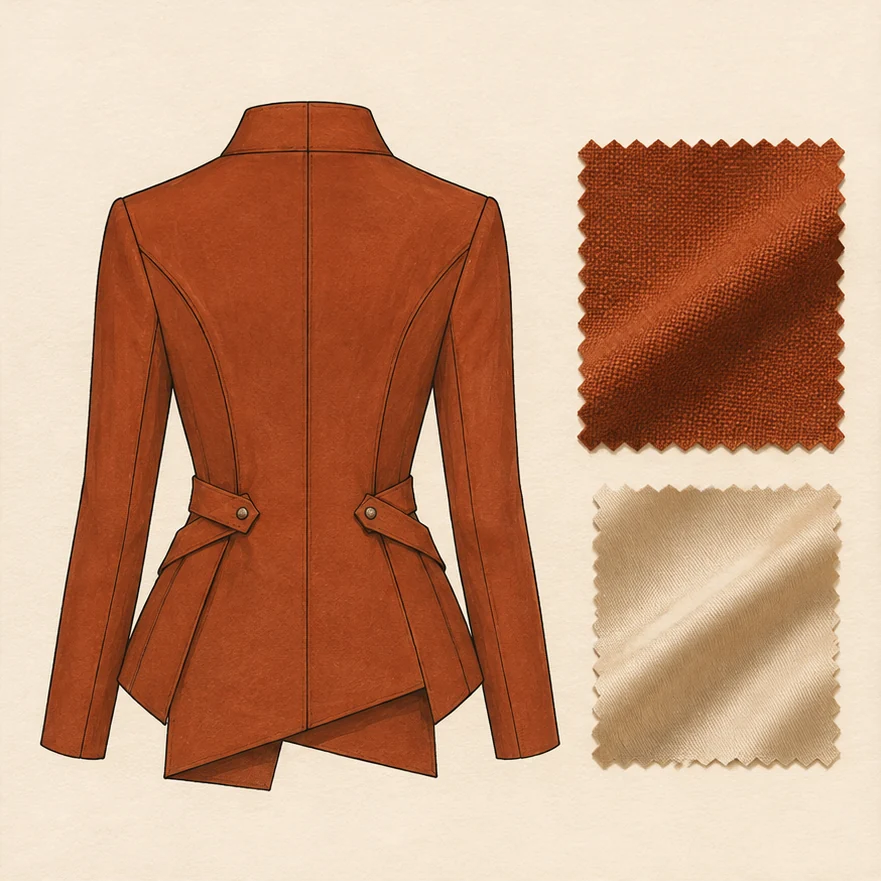
Lay a back flat beside an expressive drawing of the same jacket. The expressive drawing may use a dark brushstroke to communicate weight at the shoulder. The flat can show exactly where the back yoke ends, whether a seam crosses the shoulder and how the sleeve attaches. Decide what a person could make or recognize from each drawing. When a brief asks for a back technical flat, make the back intelligible on its own. An attractive back pose can hide the very feature the reader needs to see.
Pick three landmarks and trace them across the views with your finger. Start at the neckline, follow the shoulder seam, and finish at the level of the underarm. Does the front drawing imply a raised shoulder that disappears in the back? Does the fastening appear to switch sides because you mirrored a file? A small discrepancy might be something you corrected while sewing. If so, use the corrected design consistently in the finished views, and retain the earlier drawing in your working record with a date.
Look again at fabric behavior. A stiff sample can hold the projections made by folded paper. A softer one may make a quieter sleeve and a completely different jacket. For a concept-led presentation, a photograph comparing those results may explain your choice. For a specified fabric-swatch area, supply the actual information requested for the chosen material. A square of digitally sampled brown tells a reader almost nothing about the cloth’s weave or fiber. Good editing matches the evidence to the place where someone expects to find it.
Decide what you can reuse and what you need to remake
Write the file names from your source folder down the left side of a sheet. Mark each as potentially useful for Parsons, FIT or both. Add a short condition to each mark. A photograph of your own sewn jacket might travel to both, provided the pose and view suit the relevant section. An original canvas painting might contribute to each in a different context. A commercial pattern envelope, by contrast, records where a pattern came from. It does little by itself to show how you cut, sewed or finished the garment.
Distinguish reuse of your own work from recycling a page layout. A broad, quiet project page can give breathing room to a strong drawing in one application. On a page required to carry a figure, fabric information and related views, the same generous margin may reduce the drawing until it is difficult to read. Print the two candidate pages at a modest size or open them side by side on a laptop. Check which details vanish first. Make those details larger if they are essential to the assignment.
A common point of confusion is the word “digital.” You can draw a line yourself on a tablet and make a wholly different set of decisions from someone prompting software to invent a garment. Read each school’s policy for the exact program. Parsons asks applicants to explain AI assistance and asks them to leave fully generated images out. FIT’s Fall 2027 Fashion Design AAS brief has tighter restrictions covering concept development, visuals and essay development. Keep a clear record of your own sources and process from the start. Parsons policy · FIT policy
A practice edit for a family or classroom table
Ask one reader to act as a person seeing the project for the first time and a second reader to use the FIT checklist. Give both exactly the same draft material. The first reader should tell you where their eye went and what they think changed during development. The second should point to the image that satisfies each requested component. Write down the disagreements. You might discover that the clearest concept page contains no usable rear view, while your most accurate drawing makes the sleeve experiment difficult to notice.
Change one thing for each reader. For the first, swap a repeated finished pose for a movement study. For the second, make the back flat readable and check its consistency with the garment drawn on the figure. Then ask the readers to repeat the exercise without hearing your explanation. If you have to narrate five minutes of backstory before someone can distinguish the alternatives, reconsider the order or the viewpoint. Preserve both drafts. They give you evidence that the edit improved the presentation rather than merely making it look different.
If you have only yourself to work with, leave the files overnight. Open them the next day in the order someone else would see them. Use the first minute to describe what catches your attention, then do a slow audit against the instructions. Time yourself only to break the habit of zooming into a favorite detail before you have seen the whole. You are trying to reproduce unfamiliarity, not predict how many seconds an admissions reader spends on a slide.
Read a possible submission as an outsider
Try this short audit with a single jacket file. Its name says “final,” but the picture contains only a front figure in a three-quarter pose against a chair drawing. A family member can see the resemblance between the bent leg of the chair and the sleeve. They cannot tell whether the sleeve opens at the back. On the Parsons worksheet, the relationship between the objects may justify keeping the page. On the FIT worksheet, you would need to locate the appropriate back flat and other specified elements before marking the relevant assignment ready.
Now suppose you find a beautiful back photograph of the jacket on a friend. It reveals a vent hidden from the front. On a concept page it could resolve a genuine question. In a drawing assignment specifying a technical flat it supplies reference material for the drawing you still need to make. In a sewing assignment it might serve as a required view if it meets the presentation instructions and shows the actual garment you sewed. One file can therefore be ready to submit, a useful studio reference, or beside the point depending on where you place it.
That is a useful distinction to explain to anyone helping you. Ask a teacher to write one of three words beside each file: submit, reference, or develop. Write the program and section immediately after it. You will leave the meeting with a shorter, more precise task list than a collection of general reactions to the drawings.
Put your remaining hours where they count
With a month available, identify the longest physical dependency first. A fabric purchase, access to a sewing machine, a fitting with another person or a session with a dress form can hold up several later steps. Arrange those early. Drawing and writing can often move in parallel. Keep a little list of quiet tasks for the days when you have only half an hour. Checking captions against actual decisions, naming files and comparing reverse views are all productive uses of a short evening.
With a week available, do two different audits. For FIT, check completeness against the instructions for the term before spending time on polish. For Parsons, lay out the sequence as a reader would see it and locate any piece whose role remains unclear. Then check the application fields and required descriptions. Open the exported images, ideally on a second device. A strong drawing in the wrong file or a reverse view exported at postage-stamp size is a fixable error if you notice it before submitting.
Finish with two sentences in your own notes. For Parsons, say what a reader learns about your interests and how the jacket contributes to that impression. For FIT, identify the assigned components the jacket actually completes and the evidence that proves it. If you can answer both precisely, you have done the most useful part of comparing schools: you understand what work belongs in tomorrow’s studio session.
For the wider program decisions, read the Parsons Fashion Design BFA review and the FIT Fashion Design AAS review. For help deciding what to revise across two different briefs, see Helen Sotropa’s private portfolio review.