
Parsons Fashion Design BFA Review and Portfolio Requirements
Fashion school admissions blog · Reviewed November 22, 2026
Before you photograph another look for Parsons, cover every caption in your draft. Can someone tell which idea made you cut, weave or construct something differently? A portfolio for the Fashion Design BFA in New York gives you relatively few slides and considerable freedom in what they contain. Deciding what deserves a second image is part of the design work.
What you actually study at Parsons
The 120-credit BFA begins with a shared first year of art and design. From year two, fashion students explore how an idea moves between drawing, material investigation, three-dimensional work and time-based practice. The senior thesis is self-proposed. Possible outcomes include garments, objects, textile research and a documentary. If you want to investigate how people dress as well as learn how to make clothing, that breadth gives you room. Expect to make a case for your own direction as the work progresses. Parsons BFA curriculum
Parsons lists four pathways. Womenswear and Menswear offer garment-centered directions. Fashion Product makes room for objects such as accessories. Fashion Textiles puts material development at the center. Think about the last project you stayed up late to finish. Were you resolving a sleeve, engineering a clasp or trying to make a yarn hold a fold? Your answer is a better starting point for comparing pathways than the job title you hope to have at graduation. Fashion design pathways
What the Parsons application portfolio asks for
First-year BFA applicants submit eight to twelve slides. A slide can contain more than one image, and the school welcomes work across media. Parsons advises against submitting fashion styling made with purchased garments. Before selecting photographs from a styled shoot, identify your contribution. A coat you cut and constructed, a print you developed or an image you composed each demonstrates a different skill. Label the contribution precisely. Transfer applicants should read the separate guidance that applies to their work and entry level. First-year portfolio guidance
How to edit a multi-image slide
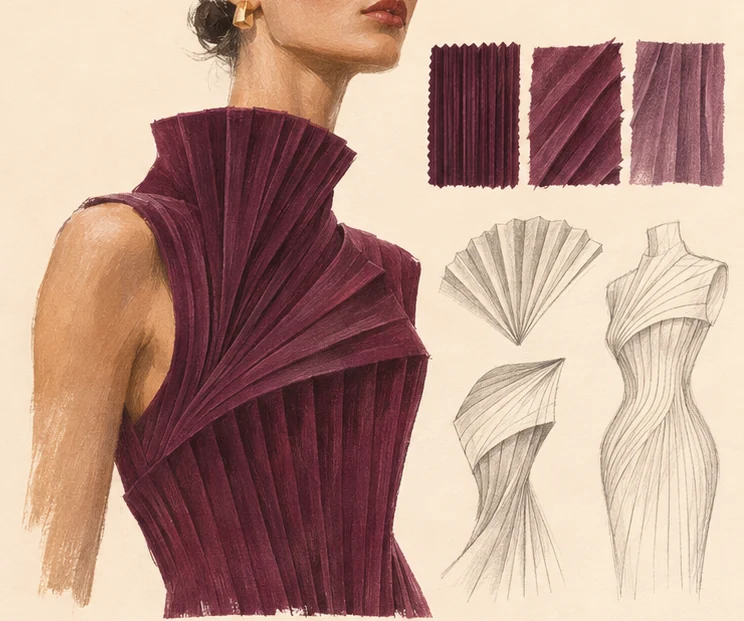
Imagine a pleated collar that keeps springing open. Place the failed paper model beside the fabric version, turn both to the same angle and crop them to a comparable scale. Someone looking at the pair can see the change in the fold. Use a short caption to explain why you moved the line of stitching. Give the final collar on the wearer a larger image if scale against the neck matters to the idea.
Export that slide and open it at ordinary laptop size. If a reader has to zoom in to see the stitch line, remove an image or give the detail its own slide. Then consider what you displaced. An independent drawing might introduce a quality of line that the entire collar project leaves unseen. An edit earns its place by telling the reader something specific about your decisions.
Who should shortlist Parsons?
Parsons is worth a close look if your interests cross clothing, textiles, objects and visual research, and you enjoy explaining how those interests connect. If you already know you want a prescribed garment assignment as part of admission, compare FIT’s AAS brief alongside this one. When planning a New York visit, ask to see work from the common first year and one second-year fashion studio. Those two views will tell you more about how you will spend your early semesters than a thesis exhibition alone.
Do all my Parsons portfolio slides have to show clothes?
No. Its published first-year guidance explicitly allows other media. A sculpture that shows how you handle balance or a print series that led you to design textiles can give the reader a reason to understand your fashion work differently. Pick the piece you can discuss in concrete terms. First-year portfolio guidance
Continue your portfolio research
Read the Fashion Institute of Technology review or compare all ten U.S. fashion design programs. For feedback on your own draft, see Helen Sotropa’s private fashion portfolio review.